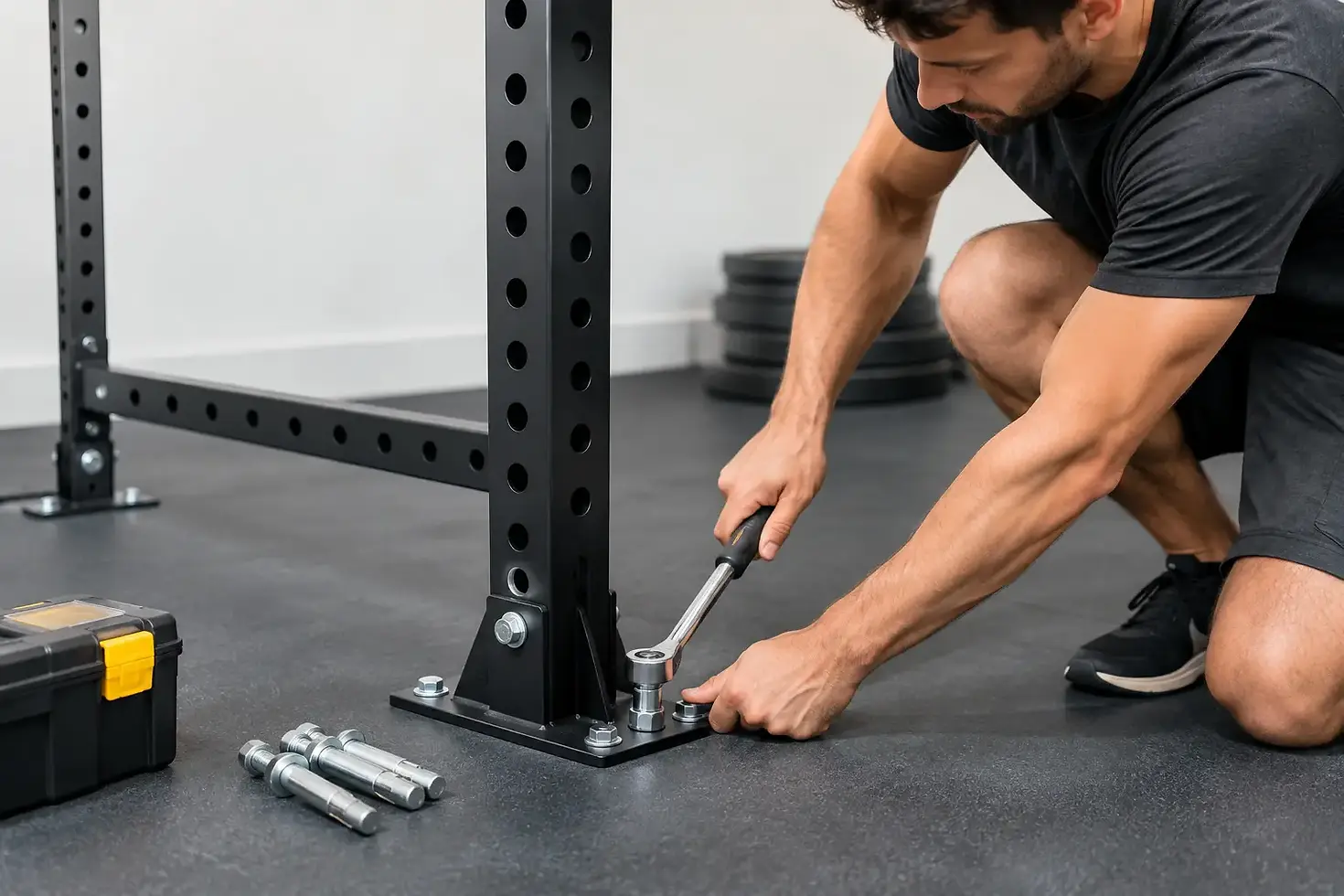
How to Install Secure Squat Rack Anchors Safely

A squat rack can look perfectly stable until a lifter misses a re-rack, uses band resistance, or stores a loaded bar unevenly. Secure squat rack anchors turn the rack, floor, and installation surface into one safe system. For commercial gyms, apartment fitness centers, hotels, and serious home gyms, that connection helps reduce movement, equipment damage, and preventable liability.
Anchoring is not simply a matter of drilling holes and tightening bolts. The correct method depends on the rack design, the flooring system, the concrete slab, the manufacturer’s requirements, and how the equipment will actually be used. A rack installed for light residential training has different demands than a multi-user facility where members train throughout the day.
When Secure Squat Rack Anchors Are Needed
Many power racks, half racks, and functional training rigs are designed to be anchored. Some may be stable without floor mounting when they have a wide base, integrated weight storage, or a specified stabilizing system. That does not automatically mean they are the right choice for every location.
Anchoring is generally the safer decision when the rack will support heavy barbell work, pull-ups, kipping movements, suspension training, resistance bands, or multiple users. These exercises create forward, lateral, and upward forces that can shift an unanchored frame over time. A rack that moves even slightly can loosen fasteners, damage flooring, and make users less confident under load.
Commercial settings deserve particular attention. A gym owner or property manager cannot assume every member will load, re-rack, and use the rack correctly. Equipment should be installed for real-world use, including sudden impacts and repeated use by people with different skill levels.
Manufacturer instructions should always come first. If a rack manufacturer requires anchoring, that requirement is part of safe installation, not an optional upgrade. It may also affect warranty coverage and the facility’s ability to document that equipment was installed according to specifications.
Start With the Floor, Not the Rack
The floor structure determines what type of anchor can be used and whether anchoring is appropriate at all. In most commercial fitness spaces, racks are anchored into a properly sized concrete slab. The rack may sit on rubber flooring, but the anchors need to reach the structural concrete below, not just grip the rubber surface or a thin underlayment.
A technician needs to verify slab condition, thickness, and potential obstructions before drilling. Cracked concrete, uneven surfaces, previous patching, moisture issues, and concealed utilities can all affect the installation plan. Drilling into an unsuitable area can weaken the fastening point or create a costly repair.
Post-tension concrete requires additional caution. Many condos, apartment buildings, and commercial properties use post-tension slabs that contain tensioned cables. Drilling without identifying those cables creates a serious safety and structural risk. The same concern applies to unknown plumbing, electrical runs, radiant heating components, and other embedded systems.
Wood-framed floors present a different challenge. Anchoring a heavy rack to plywood alone is not a dependable solution. The attachment must be designed around the floor joists and building structure, or the rack may need a manufacturer-approved freestanding configuration. This is one area where a quick install can become a long-term problem if the floor is not evaluated first.
The Right Anchor Is Part of the System
Anchor selection is not one-size-fits-all. Concrete wedge anchors, sleeve anchors, and other fastening systems have different performance characteristics. The appropriate choice depends on the rack’s mounting holes, the slab, required embedment depth, and the anticipated loading.
The anchor must be compatible with the rack base and installed at the correct depth and spacing. Improper spacing can reduce holding strength. Fasteners that are too short may not achieve reliable engagement with the concrete, while drilling too deeply can introduce other risks. Tightening also matters. Under-tightened anchors can loosen, while over-tightening can damage threads, distort a rack foot, or compromise the concrete around the anchor.
Flooring thickness must be included in the measurement. Rubber tiles and rolled rubber flooring can compress, especially beneath a rack foot. If the installer measures only from the top of the rubber without accounting for compression and concrete depth, the anchor may not perform as intended.
A professional installation also protects the finish of the equipment. Rack feet should sit level, the frame should be square, and mounting hardware should be positioned so it does not create sharp edges, trip hazards, or interference with platforms and flooring seams.
Leveling Matters Before Final Tightening
A rack can be anchored firmly and still perform poorly if it is not level. Small changes in slab elevation, worn flooring, or an uneven platform can leave one or more rack feet unsupported. When the rack is loaded, it may rock, twist, or place unnecessary stress on the uprights and hardware.
Before final tightening, the installer should check that all contact points are supported and that the uprights are plumb. Shims, leveling methods, and layout adjustments may be needed depending on the rack design and surface condition. Once the rack is properly positioned, anchors can be set and tightened according to the equipment and fastening requirements.
This process is especially important for connected functional rigs. A long wall-mounted or floor-mounted system can magnify a small alignment issue across multiple stations. Proper layout protects both the equipment and the space needed for safe lifting, spotting, and traffic flow.
Do Not Ignore the Rack’s Intended Use
The way a rack is used should shape the installation plan. A basic squat stand used for controlled barbell work has different needs than a rack used for heavy squats, pull-up stations, dip attachments, landmines, battle ropes, and banded lifts.
Bands deserve special attention because they can generate significant horizontal pull. A rack that feels stable under a barbell may move when resistance bands are stretched from its base. Similarly, pull-up and kipping use create repeated dynamic forces that can work against an unanchored or improperly anchored frame.
Storage also changes the equation. Weight horns, plate pegs, and accessory storage may improve stability, but they do not replace proper anchoring when the manufacturer requires it. They can also change how forces are distributed across the rack and floor.
For facilities with several racks, planning should account for clearance around each station. Members need room to load plates, use safety arms, access a bar, and exit the lifting area without crossing another person’s path. A secure installation is not only about the bolts below the rack. It is also about creating a usable, organized training zone.
Inspection Should Continue After Installation
Anchors should be inspected as part of routine equipment maintenance. High-use facilities should look for loose hardware, cracked concrete around anchor points, shifting rack feet, damaged flooring, corrosion, and upright movement. Staff should also report any rack that rocks, squeaks, or feels different during use.
Re-tightening is not always the answer. If an anchor has loosened repeatedly, the underlying issue may be an improper anchor type, worn hole, damaged slab, rack misalignment, or a force the original installation did not account for. Continuing to tighten a compromised fastener can hide a problem rather than correct it.
Relocation requires the same care as initial installation. When a gym changes its layout, replaces flooring, or moves equipment to another suite, old anchor holes need to be evaluated and repaired appropriately. The new location should be assessed from the beginning rather than assuming the previous installation plan will transfer.
Get Installation Right Before the Rack Goes Into Service
Squat racks are built to handle demanding training, but their performance depends on the surface beneath them and the quality of the installation. A properly anchored rack stays where it belongs when members train hard, staff can operate with greater confidence, and facility owners have fewer equipment-related concerns to manage.
Gympro Service provides professional fitness equipment assembly, installation, relocation, and preventative maintenance throughout Palm Beach County and Broward County. If a rack needs to be anchored, moved, inspected, or reinstalled after new flooring, experienced service helps protect your equipment, your users, and your operation. Before the first loaded bar reaches the hooks, make sure the rack is installed for the work it is expected to do.


Comments